Monday, January 11, 2010

A Great Way to Warm Up and Recover After A Cold Ride...


During this time of year many of you are out there putting in the miles and the hours - many of which are not in the most pleasant of conditions. Its cold, rainy, windy, overcast, snowy - sometimes JUST PLAIN MISERABLE! Trust me, I've had those rides (very recently!)....but base miles are crucial because its this time of year when the 'foundation' is laid for the rest of the season. Whenever you're thinking of an excuse to not get outside, just realize that the person who beats you in June (or whenever) - they didn't use that excuse!


In order to help make some of these cold and miserable workouts a little more bearable, we've developed a 'Muscle Recovery Soak' for use after your workouts. One of our previous blog entries was about the benefits of soaking in Epsom Salts. We explained that the magnesium is helpful in reducing inflammation and relieving pain. Well, we've made this 'Muscle Recovery Soak' with some enhanced features - all to help you 'RecoverBetter'..... besides Epsom Salt, we've added Dead Sea Salt, Eucalyptus, and Peppermint Oil.

Just add about 8 oz. (1/4 of container) to a warm bath or whirlpool and soak for at least 15 minutes.

On sale now at RecoverBetter.com for $12.99!


Sunday, December 13, 2009

Get your blood flowing....the SIMPLE explanation for Compression


One of the best methods out there for reducing recovery time is compression - but there seems to be some misconception and confusion out there as to what these garments ACTUALLY do. Compression garments have long been used in medical settings to help patients recover better from surgery.

But the simple reason for athletes to utilize compression is that it aids in increasing blood flow BACK to the heart. This increase in blood flow reduces the swelling and inflammation therefore allowing the muscles to rebuild from the microscopic tearing of muscle fibers (Exercise Induced Muscle Damage or EIMD).

It should be noted that compression garments - particularly calf sleeves and arm sleeves SHOULD be tighter at the furthest point from the heart (i.e. ankles and wrists). The pressure should DECREASE within the garment as it moves closer to the heart. This is called Graduated Compression and is essential to the effectiveness of compression garments. When combined with the muscle pump effect of the calf, graduated compression promotes increased circulation of blood and lymph fluid through the legs.

Check out RecoverBetter.com for compression gear from Zoot and Zensah -- both featuring Graduated Compression engineered for improving athletic performance.


Saturday, December 5, 2009

Tuesday, December 1, 2009

Cold Compression Therapy

Ice Baths -- recovery or torture?? Well, a little of both I suppose. There are definitely benefits to taking a dip in icy water after a hard workout. The theory goes that exposure to the cold will constrict the blood vessels and reduce inflammation in damaged muscles. Then after warming back up, blood flow is restored and helps to flush lactic acid and metabolic wastes from the damaged muscles. This helps to reduce the dreaded DOMS or Delayed Onset Muscle Soreness. You know -- the achy sore feeling that hits you about 24-48 hours after a really hard workout.
There are a lot of pro and elite athletes that swear by this method for recovery............ but if you're like me (i.e. NOT A PRO or ELITE athlete) then submerging yourself in freezing cold ice water isn't a very practical or appealing method.

So, you ask, what are the alternatives??


Cold Compression Therapy! There are several brands and methods out there but the best one I've found so far is made by Recover Gear. They use a compression garment which has pockets over the muscles for inserting a Thermafreeze ice pack. The Thermafreeze pack can also be heated up for warming therapy as well. They've got a complete line with shorts, tights, calf sleeves to ankle, knee and even shirts. Set up time is quick - just throw the shorts on and insert the frozen packs. (No waiting for the bath to fill up and dumping ice) You can wear the shorts underneath a pair of baggies or just by themselves. This past summer on long rides and runs, I would be 'craving' my Recover Gear shorts. The cold packs really felt great on my legs after being out in the 95-100 deg Florida heat for 4-6 hours. I could always tell a difference after using the Recover Gear. My legs wouldn't have that 'dead' feeling later in the day or even for the next day's training.


The Recover Gear method is by far the easiest way to ice down your legs, joints, or upper-body after a hard workout or even if you're injured. Check out the complete line of Recover Gear Products here.


Sunday, November 15, 2009

So you may have been wondering........

........ what is this RecoverBetter.com all about? Well, coming soon - we're going to be switching over to our online store which will feature gear and products designed to help athletes like you to GET FASTER BY RECOVERING BETTER.

We will have the best recovery products from manufacturers like Zoot, Zensah, Pacific Health Laboratories, Qoleum, TriggerPoint Therapy, Nubound, RecoverGear, and more.

This aspect of an athlete's training program should not be overlooked - as 'Recovery' is where the training is 'realized' by your body as it adapts and rebuilds from the stress and overload of training. Our products will provide a benefit to the athlete in that they will be able to reduce their recovery time and maximize the rebuild cycle.

We'll be selling products that are tried and tested by actual athletes (like us) who train and compete. If we don't use it - we won't sell it. That's our promise to you.

So check back soon - we should be up and running SOON!
Thanks -
Sean and Stephanie

Saturday, November 7, 2009

Self Myofascial Release Therapy

Self myofascial release therapy (SMRT) is becoming more and more prominent amongst athletes who are looking for relief from injuries and their chronic aches and pains that are commonly associated with training loads.

Fascia & Trigger Points
Fascia is a specialized connective tissue layer surrounding muscles, bones and joints and gives support and protection to the body. It consists of three layers - the superficial fascia, the deep fascia and the subserous fascia. Fascia is one of the 3 types of dense connective tissue (the others being ligaments and tendons) and it extends without interruption from the top of the head to the tip of the toes.
Fascia is usually seen as having a passive role in the body, transmitting mechanical tension, which is generated by muscle activity or external forces. Recently, though, some evidence suggests that fascia may be able to actively contract in a smooth muscle-like manner and consequently influence musculoskeletal dynamics.

Trigger points have been defined as areas of muscle that are painful to touch and are characterized by the presence of taut bands. Tissue can become thick, tough and 'knotted'. They can occur in muscle, the muscle-tendon junctions, and / or bursa. Trigger points can be accompanied by inflammation. It is important to know that if trigger points remain untreated for a long duration, the once healthy fascia is replaced with inelastic scar tissue.

Trigger points can compromise the tissue structure in the area in which they are located, placing a greater strain on other tissues that must compensate for its weakness. These in turn can break down and so the spiral continues. According to many therapists, trigger points in the fascia can restrict or alter the motion about a joint resulting in a change of normal neural feedback to the central nervous system. Eventually, the neuromuscular system becomes less efficient, leading to premature fatigue, chronic pain and injury and less efficient motor skill performance.

Trigger points can be caused by:
  • Acute physical trauma
  • Poor posture or movement mechanics
  • Over training
  • Inadequate rest and recovery between training sessions
  • Nutritional factors

Self myofascial release therapy is a relatively simple technique that athletes can use to alleviate trigger points. Studies have shown self myofascial release to be an effective treatment for myofascial pain syndrome and relief from injuries.


Listed below are some Self Myofascial Release Therapy exercises that you can perform yourself to help you RecoverBetter........
For these exercises you will need a foam roller........

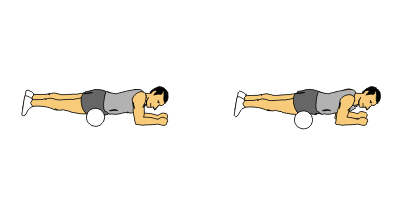
Adductor Self Myofascial Release.
1.Extend the thigh and place foam roll in the groin region with body prone (face down) on the floor.

2. Be cautious when rolling near the adductor complex origins at the pelvis.

Once a “tender point” is located, stop rolling, and rest on the tender point until pain decreases by 75%.

Hamstring Self Myofascial Release
1. Place hamstrings on the roll with hips unsupported.

2. Feet can be crossed so that only leg at a time is one the foam roll.

3. Roll from knee toward posterior hip.

Once a “tender point” is located, stop rolling, and rest on the tender point until pain decreases by 75%.

Quadriceps Self Myofascial Release
1. Body is positioned prone (face down) with quadriceps on foam roll

2. It is very important to maintain proper core control (abdominal drawn-in position & tight gluteus) to prevent low back compensations

3. Roll from pelvic bone to knee, emphasizing the lateral (outside) thigh

Once a “tender point” is located, stop rolling, and rest on the tender point until pain decreases by 75%.

Iliotibial Band Self Myofascial Release
1. Position yourself on your side lying on foam roll.

2. Bottom leg is raised slightly off floor.

3. Maintain head in “neutral” position with ears aligned with shoulders.

4. This may be PAINFUL for many, and should be done in moderation.

5. Roll just below hip joint down the outside thigh to the knee.

Once a “tender point” is located, stop rolling, and rest on the tender point until pain decreases by 75%.

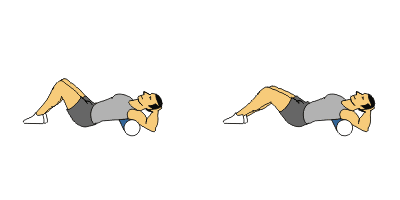
Upper Back Self Myofascial Release
1. Place hands behind head or wrap arms around chest to clear the shoulder blades across the thoracic wall.

2. Raise hips until unsupported.

3. Stabilize the head in a “neutral” position.

4. Roll mid-back area on the foam roll.
Once a “tender point” is located, stop rolling, and rest on the tender point until pain decreases by 75%.


General Guidelines

· Spend 1-2 minutes per self myofascial release technique and on each each side (when applicable).
· When a trigger point is found (painful area) hold for 30-45 seconds.
· Keep the abdominal muscles tight which provides stability to the lumbo-pelvic-hip complex during rolling.
· Remember to breathe slowly as this will help to reduce any tense reflexes caused by discomfort. · Complete the self myofascial release exercises 1-2 x daily.

Tuesday, November 3, 2009

Recovery Benefits of Compression

Compression helps stabilize muscle tissue after a tough training session or strenuous competition, keeping the swelling and inflammation of muscle fibers at a micro and manageable level - this allows the muscles to rebuild themselves. Compression lets the athlete wake up the next day feeling fresh and rejuvenated instead of feeling the aches and pains typically associated with post-workout muscle fatigue and stress. This is how athletes get better, faster and stronger. Gravity can cause a build-up of fluid and metabolic waste in the muscles and surrounding tissue, especially after exercise, which increases swelling and increases recovery time. Exercise causes muscle damage, including micro-tears leading to inflammation. Compression helps reduce inflammation that might slow down the recovery process and therefore helps reduce Delayed Onset Muscle Soreness (DOMS).

Benefits of Wearing Compression Garments:

o Improved Circulation – faster warm up and recovery. When the blood can travel through your body faster the muscles will get the needed fuel quicker and reduce fatigue.
o Reduced Recovery Time due to the improved circulation muscles have less lactic acid build up thus reducing soreness and allowing you to train harder.
o Increased Endurance the tightness of the clothing decreases vibration of muscles thus increasing your ability to train and race longer.
o UV Protection – UPF 50+ protection from the sun´s harmful rays – while training and racing.